Meko Documentation
Meko is the agent-native data layer for multi-agent systems, with shared knowledge, compound memory, and end-to-end auditable traces.
Teams still fail when agents can't share state (36% of failures trace to inter-agent misalignment); Meko treats memory and knowledge as infrastructure so agent teams stay coordinated instead of collisional.
Works with: WorkbenchLM (in-portal chat) |  Claude Code |
  Cursor |
  Codex | Claude Desktop | Kiro | ...and more
Meko offers:
Collective memory
Learning that compounds across agents, not trapped in per-agent memory silos.
Shared knowledge
A knowledge base that grows over time from conversations, real-time data sources, and slower-changing reference material.
Decision traces
Every output linked back to the conversation, reasoning, and execution that produced it.
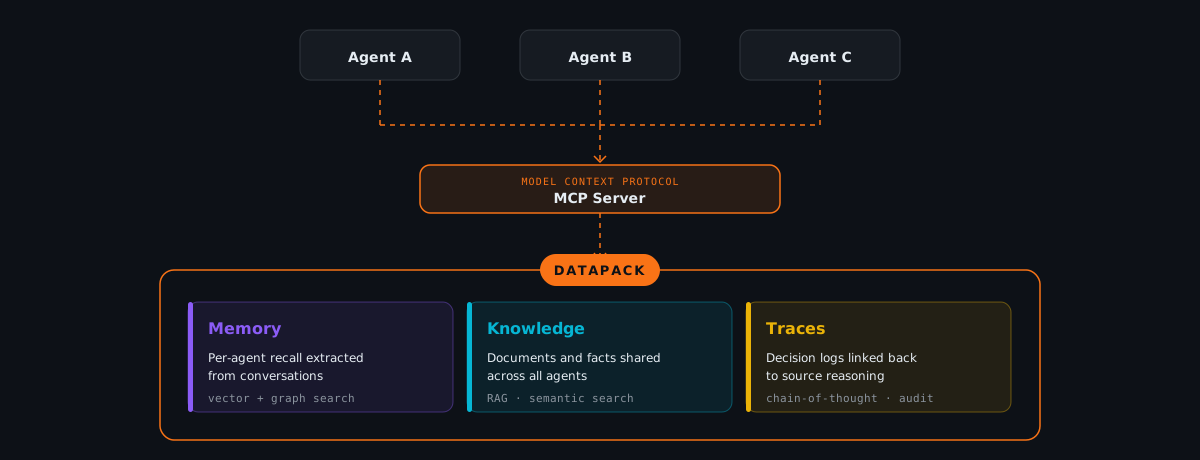
Everything lives in a datapack, the storage primitive that holds your memory, knowledge, conversation history, and traces, and is exposed via an MCP server.
Meko integrates easily with any agentic framework through MCP servers. It is serverless, multi-tenant (multi-agentic), and optimized for tiering to object stores. Built on YugabyteDB, a distributed Postgres with vector, relational, document, graph, and full-text search in one query plane. One database, no glue code.
Learn more about Meko
Quick start
Sign up, connect your AI client, and start using Meko in minutes.
Get started →Core concepts
Understand datapacks, memory, knowledge, and how Meko fits your stack.
Learn more →Examples
Hands-on labs, plus scenarios for handoffs, collective learning, and shared team standards.
Browse examples →Integrations
Wire Meko into Cursor, Claude, and other tools over MCP with the same pattern.
View integrations →Start where you fit
- I'm building agents > Quick Start
- I'm running platform > Architecture
- I'm assessing for audit > Decision traces